
Flat Metal Roof Cost 2025: Ultimate Value
Your Guide to Flat Metal Roofing Costs
Flat metal roof cost typically ranges from $5 to $30 per square foot installed, or $7,500 to $40,000 for an average 1,500-2,500 square foot roof. The wide range depends on your material choice, roof complexity, and whether you choose exposed or concealed fastener systems.
Quick Cost Breakdown:
- Standing Seam Metal Roof: $9-$16 per sq ft ($900-$1,600 per square)
- Corrugated Metal Roof: $5-$12 per sq ft ($500-$1,200 per square)
- Aluminum: $7-$15 per sq ft
- Galvalume Steel: $5-$13 per sq ft
- Copper: $15-$30 per sq ft
- Average Lifespan: 40-70 years
- Labor Costs: 60-70% of total project cost
Considering a flat metal roof for your Arizona home? While the upfront cost is higher than for asphalt shingles, metal roofs last two to three times longer and can cut cooling costs by 10-25% in Phoenix’s intense heat.
Arizona’s climate—with its monsoon storms, intense UV exposure, and extreme temperature swings—demands a high-performance roofing material. Metal roofing has become a popular choice across the state, alongside polyurethane foam.
This guide breaks down every cost factor, compares metal to alternatives like TPO and EPDM, and explains the long-term value. You’ll learn exactly what to expect when budgeting for your project.
Understanding the Total Flat Metal Roof Cost
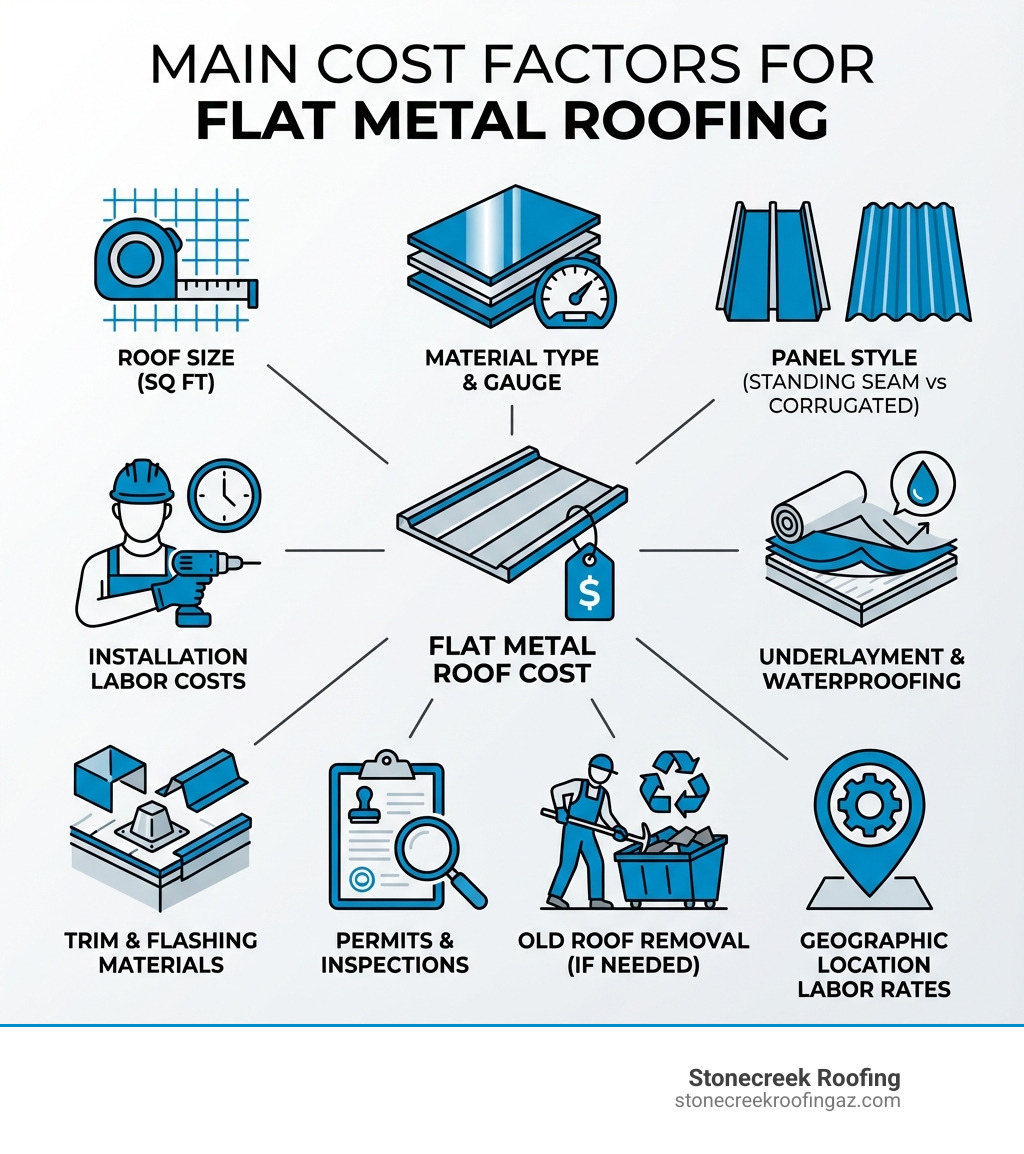
Understanding your total flat metal roof cost means looking at many variables. It’s a combination of materials, labor, and site conditions that determine the final price. For property owners in Phoenix, Tucson, and across Arizona, these factors are crucial due to our unique climate and building codes.
Let’s break down the key elements that contribute to the overall expenditure:
- Roof Size: A straightforward factor—larger roofs require more materials and labor, increasing the total cost. Roofing is measured in “squares” (100 sq ft). A 1,000 sq ft roof might cost $5,000-$16,000, while a 2,500 sq ft roof could range from $12,500-$40,000.
- Roof Complexity: Features like HVAC units, skylights, or parapet walls increase installation intricacy. Each penetration requires meticulous flashing and sealing, adding to material and labor costs. Complex designs can be 15%-25% more expensive than simple roofs.
- Geographic Location: Labor rates vary across Arizona, from the Phoenix metro to communities like Green Valley. Regional wages and cost of living can affect total costs by up to 35%.
- Labor Rates: A substantial portion of your investment, often 60% to 70% of the total project cost. Average labor cost is around $7,000 but can exceed $10,000 depending on project scale and complexity.
- Material Type: The kind of metal you choose is a primary cost driver. Generally, steel is more affordable than aluminum, which is more affordable than copper or zinc.
- Panel Style: For flat or low-slope applications, you’ll typically consider corrugated metal or standing seam panels. Standing seam, with its concealed fasteners, offers superior waterproofing and a sleeker look but comes at a higher price.
- Metal Gauge: This refers to the thickness of the metal. A lower gauge number means thicker, more durable, and more expensive metal. For residential use, 24- or 26-gauge steel is common, but thicker 22-gauge options offer improved durability.
- Underlayment: This critical layer provides an extra moisture barrier. We recommend synthetic underlayment over traditional felt for its superior water intrusion prevention, vital during Arizona’s monsoons. Costs range from $0.05 to $1.30 per square foot.
- Fasteners: The fastening method impacts cost and performance. Exposed systems are cheaper to install (30%-50% less) but need maintenance. Concealed systems (standing seam) hide fasteners, offering superior weather resistance and a longer lifespan.
- Trim and Flashing: These components seal edges, vents, and pipes to prevent leaks. Trim costs can range from $2.50 to $10.00 per linear foot, with standing seam systems typically requiring more expensive trim.
- Permits: Local municipalities (e.g., Phoenix, Tucson, Mesa) require permits for major roofing work. These fees typically range from $250 to $500 and ensure your project meets local building codes.
- Old Roof Removal: Removing an existing roof adds to the cost, typically $1,000 to $5,000, or $1 to $3 per square foot. While installing over shingles is sometimes possible, we recommend a full tear-off to inspect the deck and avoid moisture issues or voided warranties.
Breaking Down the Flat Metal Roof Cost Per Square Foot
Let’s get down to the specifics of material costs, which are a cornerstone of your flat metal roof cost. The prices below generally reflect material and installation combined, providing a comprehensive view of what you might expect to pay per square foot or per roofing square (100 sq ft).
- Steel (Galvalume): This is one of the most popular and cost-effective choices. Galvalume steel, coated with an alloy of zinc and aluminum, offers excellent rust resistance.
- Cost per Square Foot: $5-$13
- Cost per Roofing Square: $500-$1,300
- Aluminum: Lighter than steel and highly resistant to rust, aluminum is an excellent choice for heat management in our hot Arizona climate due to its reflectivity.
- Cost per Square Foot: $7-$15
- Cost per Roofing Square: $700-$1,700
- Copper: A premium, luxury material, copper is renowned for its longevity and distinctive aesthetic (it develops a beautiful blue-green patina over time).
- Cost per Square Foot: $15-$30
- Cost per Roofing Square: $1,300-$3,000
- Zinc: Another high-end option, zinc is incredibly durable and forms a self-healing patina that protects it from scratches. It’s known for an exceptional lifespan, often exceeding 100 years.
- Cost per Square Foot: $8-$16
- Cost per Roofing Square: $1,000-$2,000
Other notable materials include tin (terne), which is less common today, and specialized options like stone-coated steel or rusted (Corten) steel. Steel shingles and metal slate can range from $6-$21 per square foot installed.
How Installation Impacts Your Flat Metal Roof Cost
Installation is a crucial component of the flat metal roof cost, often the largest part of the budget. For flat roofs, specialized knowledge is paramount for proper drainage and watertightness, especially during Arizona’s monsoons.
- Labor as a Percentage of Total Cost: As mentioned, labor can account for 60% to 70% of the total project cost. This reflects the skill and time required by experienced roofing crews. Simple installation errors can lead to costly repairs.
- Exposed Fastener Systems: Often used with corrugated panels, these systems are quicker and cheaper to install. The fasteners go directly through the panels into the roof deck. However, the exposed fasteners are subject to weathering and may require periodic inspection.
- Concealed Fastener Systems (Standing Seam): Standing seam panels interlock, hiding the fasteners. This creates a more watertight surface and allows for the metal’s natural expansion and contraction with temperature changes—a critical advantage in Arizona. While more expensive to install, they offer superior longevity, often lasting 50 years or more with minimal maintenance.
- Roof Pitch and Accessibility: Even “flat” roofs have a slight pitch for drainage. Steeper pitches or roofs with difficult access (e.g., multi-story buildings) will increase labor costs. The number of penetrations like vents or skylights also adds to installation time and cost.
- Professional vs. DIY Risks: While a DIY installation seems to save on labor ($3,400 to $10,500), we strongly advise against it for flat metal roofs. It’s a hazardous job requiring special tools and expertise. Improper installation can cause leaks, void warranties, and lead to structural damage. For safety, peace of mind, and a valid warranty, professional installation is essential.
- Importance of Waterproofing: For flat metal roofs, impeccable waterproofing is non-negotiable. This involves the panels, seams, underlayment, flashing, and sealants around all penetrations. Our Arizona climate demands robust waterproofing to protect your property.
Flat Metal Roofs vs. The Alternatives
When choosing a flat roof for your Arizona property, metal isn’t the only option. Popular alternatives like TPO, EPDM, and Built-Up Roofing (BUR) each have unique costs, lifespans, and pros and cons. Comparing them helps you make an informed decision for our climate.
Here’s a comparison of common flat roofing materials:
| Feature | Metal Roofing (Flat/Low-Slope) | TPO (Thermoplastic Polyolefin) | EPDM (Ethylene Propylene Diene Terpolymer) | Built-Up Roofing (BUR) |
|---|---|---|---|---|
| Upfront Cost | $5-$30 per sq ft (material & install) – Higher end | $3.50-$14 per sq ft (material & install) – Mid-range | $5-$13 per sq ft (material & install) – Mid-range | $4-$10 per sq ft (material & install) – Lower end |
| Lifespan | 40-70+ years (standing seam) | 15-20 years (can be 30+) | 20-30 years (can be 50+) | 15-30 years |
| Key Advantages | – Exceptional durability & longevity | – Energy efficient (white surface reflects heat) | – Durable, flexible, handles temp swings (-40 to 170°F) | – Multi-layered protection, good fire resistance |
| – Excellent wind (100+ mph) & impact resistance | – Resistant to UV, chemicals, punctures | – Relatively easy to install & repair | – Good for high-traffic roofs (layered structure seals small punctures) | |
| – Energy efficient (reflects heat) | – Recyclable | – Cost-effective | – Often cheapest upfront | |
| – Low maintenance, aesthetically versatile | – Popular in AZ for reflective properties | – Can be installed in white for heat reflection | ||
| Key Disadvantages | – Higher initial cost | – Seams can be vulnerable if not properly welded | – Black EPDM absorbs heat (white available but less common) | – Heavy, long installation time, messy |
| – Installation complexity (especially standing seam) | – Quality varies by manufacturer | – Vulnerable to punctures | – Susceptible to cracking in extreme temps | |
| – Can be noisy without proper insulation | – Less resistant to certain oils/greases | – Less aesthetic appeal than metal | – Not as energy-efficient as reflective options | |
| Best Use Cases in AZ | – Long-term investment, premium aesthetics, energy efficiency, extreme weather resistance (monsoons, heat) | – Cost-effective energy efficiency, commercial/industrial, hot climates | – Budget-conscious, robust against temp swings, commercial/industrial | – Budget-conscious, high foot traffic, historical buildings |
While the flat metal roof cost is higher upfront, its lifespan and durability often make it more cost-effective long-term in Arizona’s demanding climate. TPO and EPDM are popular for reflectivity, while BUR is a budget-friendly option. Your choice depends on your budget, desired lifespan, and specific performance needs.
The Long-Term Value: Why Metal is a Smart Investment
Investing in a flat metal roof for your Arizona property may seem costly upfront, but its long-term benefits lead to substantial savings and increased value. Beyond the initial flat metal roof cost, it’s a solution that pays dividends for decades.
Exceptional Durability and Lifespan
Metal roofs are incredibly resilient. They withstand 100+ mph winds, resist hail (though large hail can cause dents), and are impervious to fire, rot, and insects. Unlike asphalt shingles with a 15-20 year lifespan, a properly installed metal roof can last 40 to 70 years or more. This means you could install one metal roof and never have to replace it.
Low Maintenance Requirements
Metal roofing requires minimal maintenance. Its surface resists moss and fungus, eliminating the need for harsh chemical treatments. While periodic inspections after storms are recommended, the general upkeep is significantly less than for other roof types, saving you time and money over its extensive lifespan.
Energy Efficiency
In Arizona’s scorching heat, energy efficiency is paramount. Metal roofs excel here due to their reflective properties. Many metal roofs feature special coatings that reflect solar radiation, preventing heat absorption into your building. This “cool roof” effect can lead to significant savings on your cooling bills.
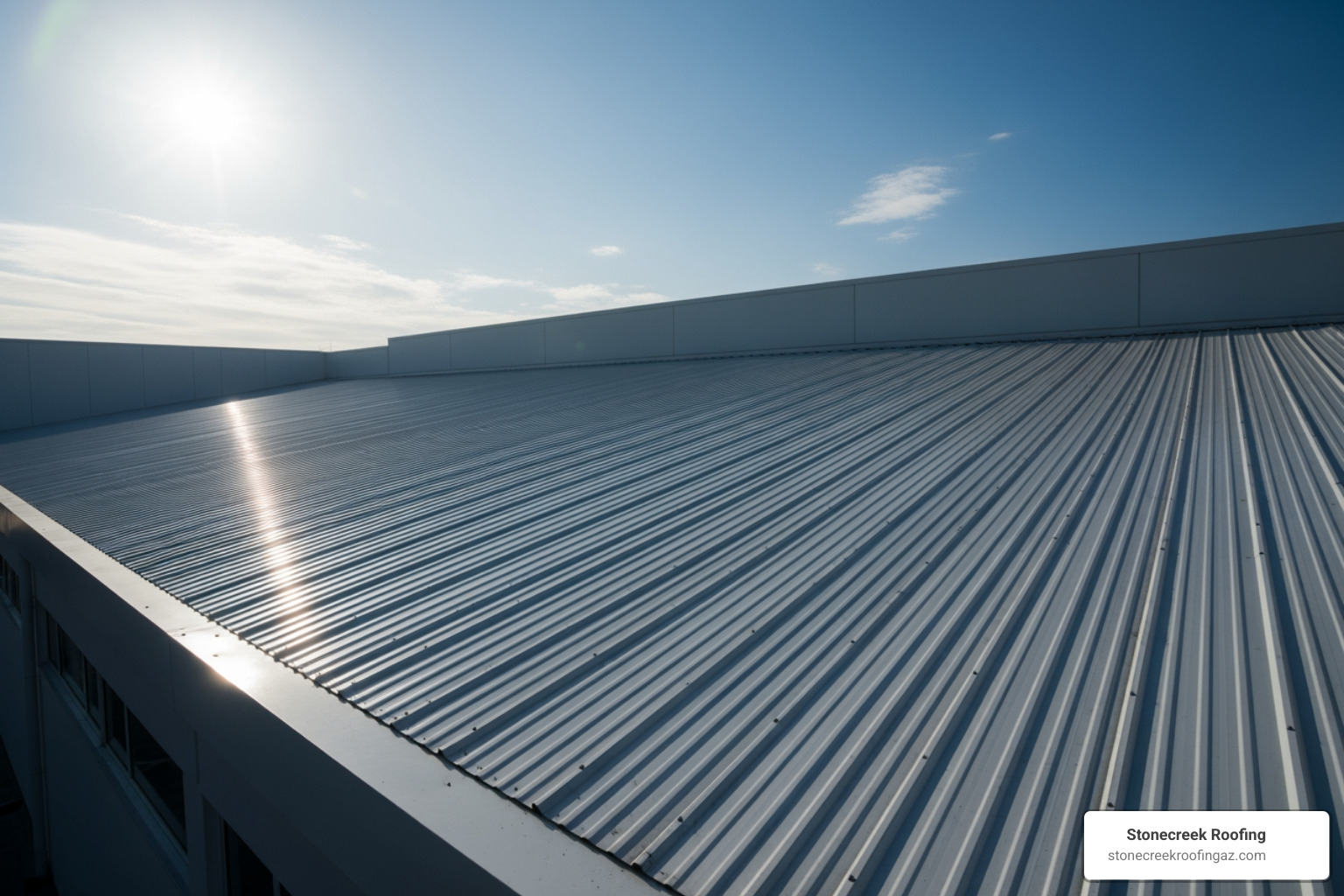
Studies suggest that metal roofs can reduce cooling costs by as much as 10-25% in hot climates like ours. When paired with proper insulation, they can also help retain heat during cooler months, providing up to a 40% reduction in heating and cooling costs combined. This is a considerable advantage for homes and businesses across Phoenix, Mesa, and Tempe, helping to offset the initial flat metal roof cost.
Eco-Friendly Materials
For environmentally conscious property owners, metal roofing is an excellent choice. Many metal roofs are made from 30-60% recycled metal and are 100% recyclable at the end of their long life. Unlike asphalt shingles, which are petroleum-based and often end up in landfills, metal offers a sustainable roofing solution.
Increased Home Value and Return on Investment
A new metal roof improves curb appeal and market value. Homebuyers appreciate its longevity, durability, and energy efficiency. Remodeling Magazine’s 2024 Cost vs. Value Report shows an average return on investment (ROI) of 48.1% for metal roof replacement, with some sources suggesting up to 60%. This makes the flat metal roof cost a sound investment in your property’s future.
Warranty Considerations
Metal roof warranties are typically robust, covering both the material and installation workmanship. Material warranties can range from 30 to 50 years or longer, covering issues like fading and corrosion. Workmanship warranties from reputable contractors like Stonecreek Roofing typically last 5-10 years, ensuring any installation-related issues are covered. Always review warranty details, as professional installation is often a prerequisite for validity.
Frequently Asked Questions about Flat Metal Roofs
We often hear common questions from property owners in Arizona about flat metal roof cost and performance. Let’s address some of the most frequent inquiries.
Can you install a metal roof over an existing flat roof?
Yes, a metal roof can often be installed over an existing flat roof (a process called reroofing or an overlay), which can save on tear-off costs.
However, there are critical considerations:
- Condition of the Existing Roof: The underlying roof must be structurally sound and free of significant damage or widespread leaks. Installing over a compromised roof will only hide problems.
- Building Codes: Local codes in Phoenix, Tucson, and other Arizona cities typically cap roofs at two layers maximum. If you already have two layers, a full tear-off is mandatory.
- Moisture Trapping: Installing metal over certain materials can trap moisture, leading to mold and deterioration of the old roof and deck. Proper underlayment and ventilation are crucial.
- Warranty Implications: Some manufacturers may void warranties if their product is installed over an existing roof or have specific requirements for such installations.
Our recommendation is almost always a full tear-off. This allows us to inspect the roof deck for hidden damage and ensure a pristine base for your new metal roof. While this adds to the initial flat metal roof cost, it guarantees the best performance and maximizes your investment’s lifespan.
Are flat metal roofs noisy when it rains in Phoenix?
This is a common misconception. Modern metal roofs, when properly installed with insulation and a solid roof deck, are generally no louder than other roofs during a rainstorm.
Here’s why the stereotype doesn’t apply today:
- Insulation: Good insulation beneath the metal panels absorbs sound.
- Roof Deck: The solid structure of your roof deck (plywood, concrete, etc.) also acts as a sound barrier.
- Underlayment: The synthetic underlayment we install provides an additional layer of sound dampening.
- Panel Design: Standing seam roofs are particularly quiet compared to older, exposed fastener roofs on uninsulated structures.
You might hear a gentle pitter-patter, not the loud, pinging noise many people imagine. If noise is a concern, we can discuss additional sound-dampening measures during your consultation.
When is a flat roof repair better than a full replacement?
Deciding between repair and replacement is a common dilemma, and the best choice depends on several factors. On average, a metal roof repair costs around $1,910, far less than the $11,736 average for a full replacement.
Here’s a breakdown to help you decide:
Repair is More Cost-Effective When:
- Localized Damage: The damage is confined to a small, isolated area, like a single puncture or loose seam.
- Younger Roof: The roof is relatively new (less than 15-20 years old) and has suffered minor, isolated damage.
- Good Overall Condition: The rest of the roof is in excellent condition with no widespread deterioration.
- Warranty Coverage: The damage is covered by your material or workmanship warranty.
Replacement is Better When:
- Widespread Damage: The roof has numerous leaks, extensive corrosion, or multiple damaged areas.
- Aging Roof: The roof is nearing the end of its projected lifespan (40+ years for standing seam).
- Structural Issues: There are underlying problems with the roof deck that require a full tear-off to address.
- Frequent Repairs: You find yourself calling for repairs every year, indicating the roof is failing.
- Energy Efficiency Upgrade: You want to upgrade to more energy-efficient materials and installation techniques.
- Increased Property Value: A new roof significantly boosts your property’s value and curb appeal.
We offer comprehensive roof inspections across our Arizona service areas. Our experts will assess your roof’s condition and provide an honest recommendation on whether repair or replacement is the most sensible and cost-effective path for your situation.
Get a Professional Flat Roof Assessment
Understanding flat metal roof cost is complex. Many factors, from material choices and panel styles to labor rates and local Arizona building codes, influence the final price, so getting an accurate estimate requires expertise.
The Importance of a Professional Quote
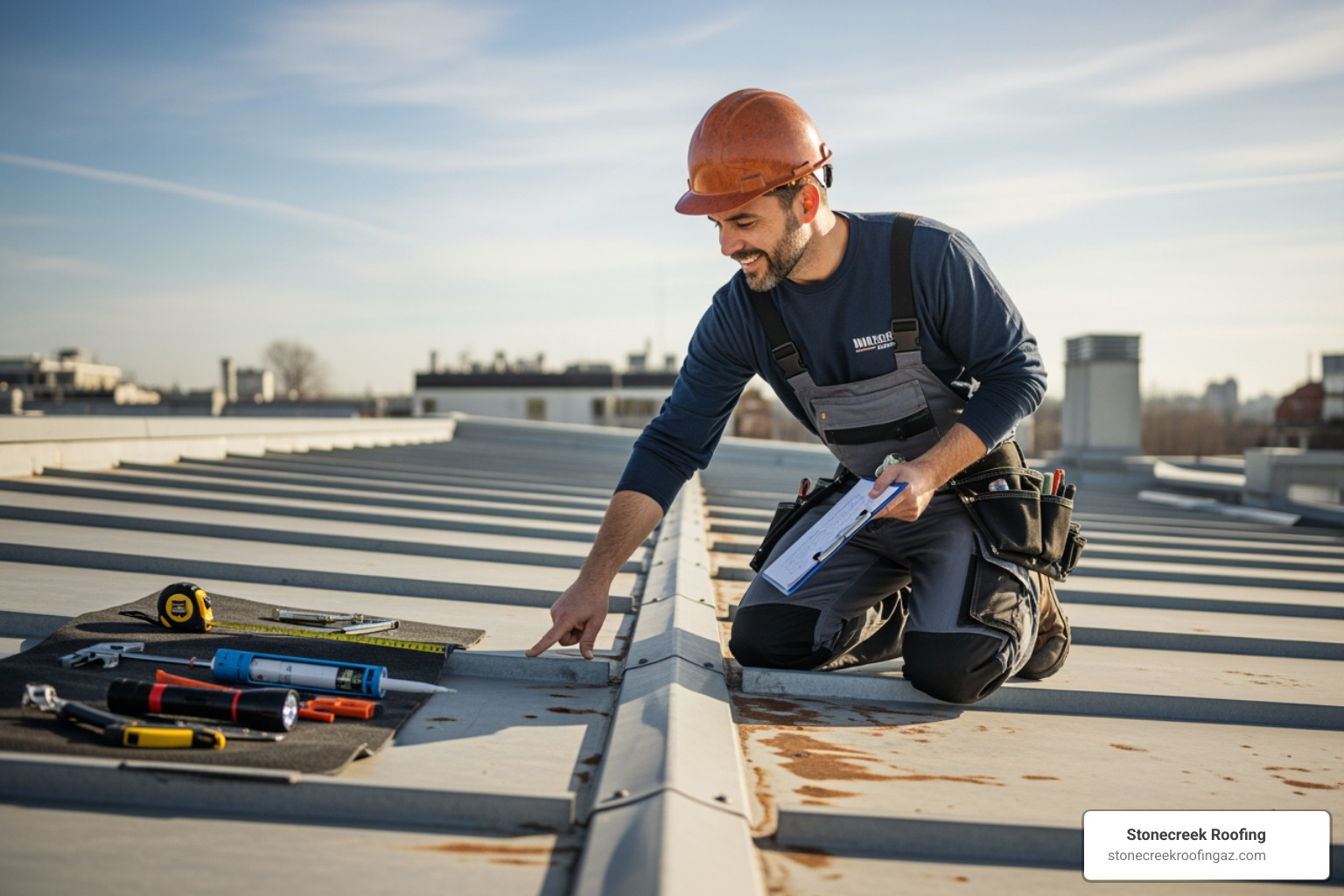
A professional quote from Stonecreek Roofing is more than a price per square foot. It provides a detailed breakdown of all costs, including materials, labor, permits, and old roof removal. This transparency helps you avoid unexpected expenses and make an informed decision.
Why Local Expertise Matters for Phoenix Weather
Arizona’s climate—intense UV radiation, extreme temperature fluctuations, and powerful monsoons—demands specialized roofing knowledge. A local company understands these challenges and can recommend the best materials and installation techniques for a long-lasting roof. Our expertise ensures your roof is built to withstand the weather across Phoenix, Tucson, Gilbert, Mesa, Glendale, Scottsdale, Tempe, Chandler, Paradise Valley, Sun City, Surprise, Goodyear, Avondale, Buckeye, Peoria, Green Valley, Summit, Littletown, Casa Adobes, Oro Valley, Payson, Prescott, Flagstaff, and Sedona.
At Stonecreek Roofing, we’re known for our customer-first approach, 24/7 emergency service, and over 500 5-star reviews. We specialize in residential and commercial repair, replacement, and installation, making us a trusted choice throughout Arizona.
Ready to explore the benefits of a flat metal roof for your property? Don’t leave your investment to chance.
Get a precise estimate for your flat roof